
Understanding Market Hours for beginner Traders
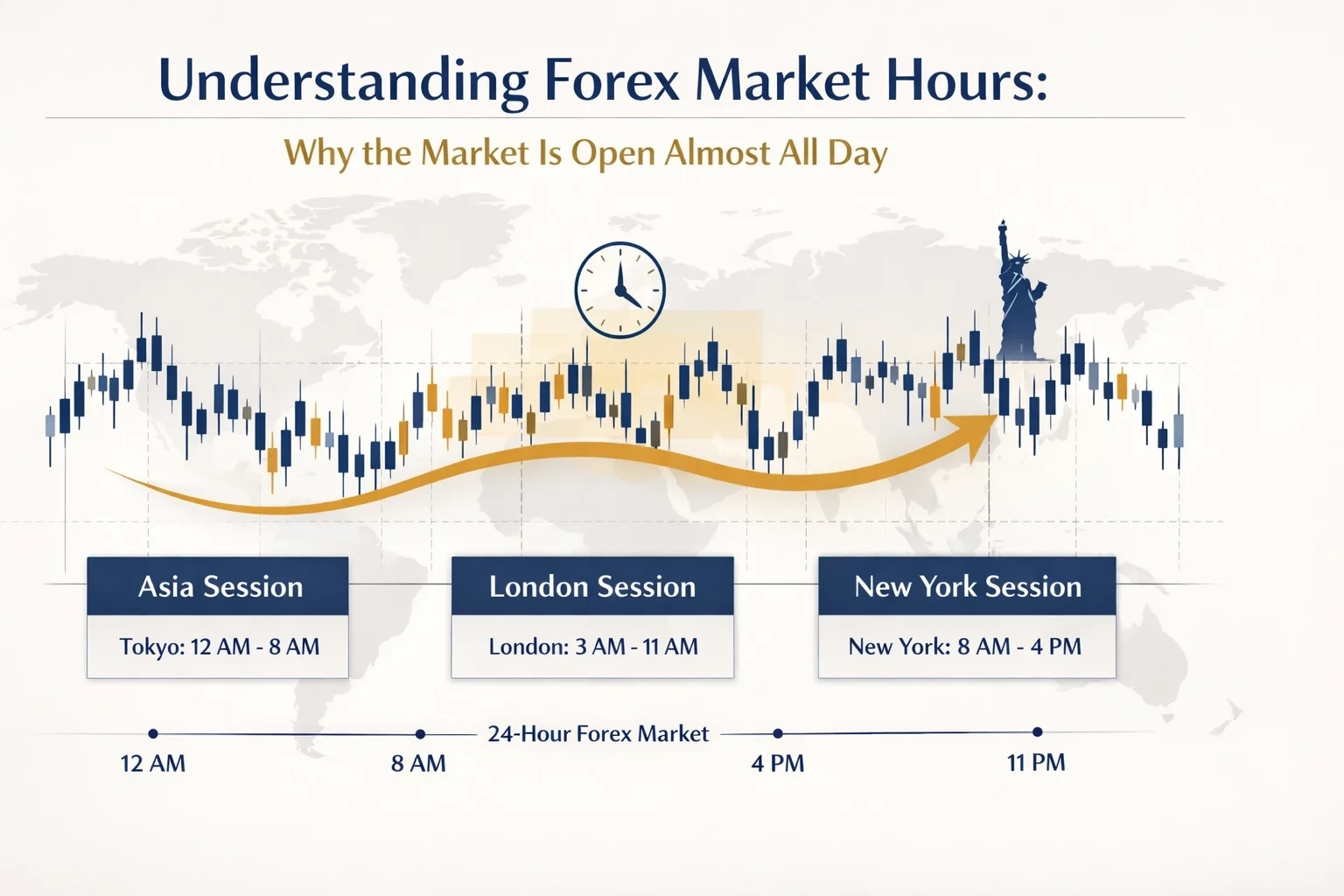
Visual: A world map with a candlestick chart overlayed and a clock for “Asia Session”, “London Session”, and “New York Session” showing a clear example of why the forex market is open 23 hours a day/5 days a week.
What are market hours in trading, and why do beginners need to understand them before they ever start watching charts too closely?
If you are used to the stock market, market hours can seem simple. The market opens, the market closes, and trading happens inside that window.
But in forex, the market works differently.
Candles keep forming through most of the day and night, which can make beginners feel like they have to keep watching all the time.
In this lesson, the goal is simple: understand how market hours work, why forex runs nearly around the clock, and why that does not mean you need to be glued to your screen.
What are market hours in trading?
Market hours are the periods when a market is open and active. In forex, the market runs about 23 hours a day, 5 days a week, because trading activity moves across major global financial centers instead of staying inside one central exchange.
Quick Answer: What Are Market Hours in Trading?
Market hours are the times when trading is active.
In forex, the market runs about 23 hours a day, five days a week.
This happens because major global sessions open and close in sequence.
Beginners do not need to watch every hour of that movement to understand the market.
How Forex Market Hours Work
Forex does not operate like a single building that opens in the morning and closes in the afternoon.
Instead, it moves through major financial centers around the world.
As one region slows down, another becomes active.
That is why the forex market continues moving through most of the day and night.
For beginners, the most important thing to understand is this:
the market may stay active for most of the day, but you do not need to be active for all of it.
Inside the broader Foundations Hub, this lesson matters because it helps you understand the environment you are looking at before you overreact to constant chart movement.
The Global Session Flow
The forex market moves through three major session groupings:
Asia session
London session
New York session
These sessions overlap as the trading day moves around the world.
That is what keeps the market active for most of the 24-hour cycle.
In practice, beginners do not need to memorize every session detail right away.
What matters most is understanding that the market keeps moving because global participation keeps rotating.
The 23-Hour Reality
You will often hear people call forex a 24-hour market.
In practice, it is closer to 23 hours a day.
Around the daily reset, there is a brief period where the market transitions into the new trading day. For beginners, the key thing to understand is that this is where one daily candle ends and the next one begins.
That daily close matters because it helps organize the full trading day into one completed bar instead of a constant stream of small movements.
How to Observe This in TradingView
One of the easiest ways to understand market hours is to look at how they show up on your chart.
In TradingView, you can check the market-status indicator next to a pair like EUR/USD.
When the market is open, TradingView will show that status and how much time remains until the daily close.
You can also stay on the Daily timeframe and observe how the full 23-hour cycle gets packaged into one candle.
That is often much calmer and more useful for beginners than staring at lower timeframes all day.
Think of It Like This
Think of forex market hours like a relay race.
The market does not stop because one region finishes. The activity gets passed from one major financial center to the next.
That is why the chart keeps moving even while you are asleep.
The point is not to chase every handoff.
The point is to understand that the full day still gets packaged into one completed daily candle.
Common Beginner Mistake: Thinking You Need to Watch the Market All Day
One of the most common beginner mistakes is assuming that because forex is open most of the day, you need to keep watching it most of the day.
That usually leads to:
over-checking charts
reacting to noise
and feeling like you are falling behind if you step away
The better habit is to understand the environment first.
Just because the market is open does not mean you need to be watching every candle it prints.
Clarity comes before complexity.
Most beginners do not struggle with effort. They struggle with structure.
Inside Foundations, these lessons are taught step by step so you can understand the market without building your routine around constant screen time.
Key Takeaways
Market hours tell you when trading is active.
Forex runs about 23 hours a day, 5 days a week.
This happens because major global sessions rotate through the trading day.
Beginners do not need to watch every hour of movement.
Understanding the daily close helps you read the market more calmly and clearly.
Frequently Asked Questions
Is the forex market open on weekends?
No. Forex generally closes on Friday and reopens on Sunday evening when the new trading week begins.
Do I need to wake up in the middle of the night to trade?
No. Beginners do not need to watch every session. The goal is to understand how the market works, not stay glued to the chart at all hours.
Why do my candles look different than someone else’s?
This can happen because different platforms or brokers use different daily reset times.
Why do market hours matter for beginners?
Market hours matter because they help beginners understand when the market is active and why candles continue forming throughout the day and night.
Next Step
Now that you understand how market hours work, the next step is learning one of the most important concepts in trading: how to think about protecting capital before chasing profit.
Read next: Risk Management Fundamentals
This Concept Is Part Of: The Agorion Method
This concept is part of the Agorion Method, specifically within the Foundations stage where traders learn how markets function before moving deeper into execution.
Market hours matter because they help you understand the rhythm of the market before you try to react to every move inside it.
Continue the Foundations Learning Path
The Foundations series walks you step-by-step from opening your first chart to understanding the core mechanics of day trading.
Foundations Lesson Index
Lesson 1 - What is Leverage in Trading?
Lesson 2 - What is a Candlestick in Trading?
Lesson 3 - Understanding the Exponential Moving Average (EMA)
Lesson 4 - Using the Long/Short Tool to Plan Trades
Lesson 5 - What does a Trending Market Look Like?
Lesson 6 - What is Consolidation in Trading?
Lesson 7 - Spread Basics for Beginner Traders
Lesson 8 - Understanding Market Hours in Trading (← You are Here)
Lesson 9 - Risk Management Fundamentals (Read Next - Linked Above)
Lesson 10 - What is Margin in Trading?
Lesson 11 - How These Trading Foundations Work Together
If you want to follow this process from the beginning, start with the Learning Path so you can see how the Agorion Method is designed to build skill step by step.
By Rachel Pennington
Rachel Pennington is the founder of The Agorion Collective, a structured trading education and community platform designed to educate and support women building real skill in the market. Her approach is rooted in clarity before complexity, teaching traders to understand price, manage risk, and develop their own process step-by-step.