
What is Leverage in Trading? A Beginner’s Guide to Buying Power
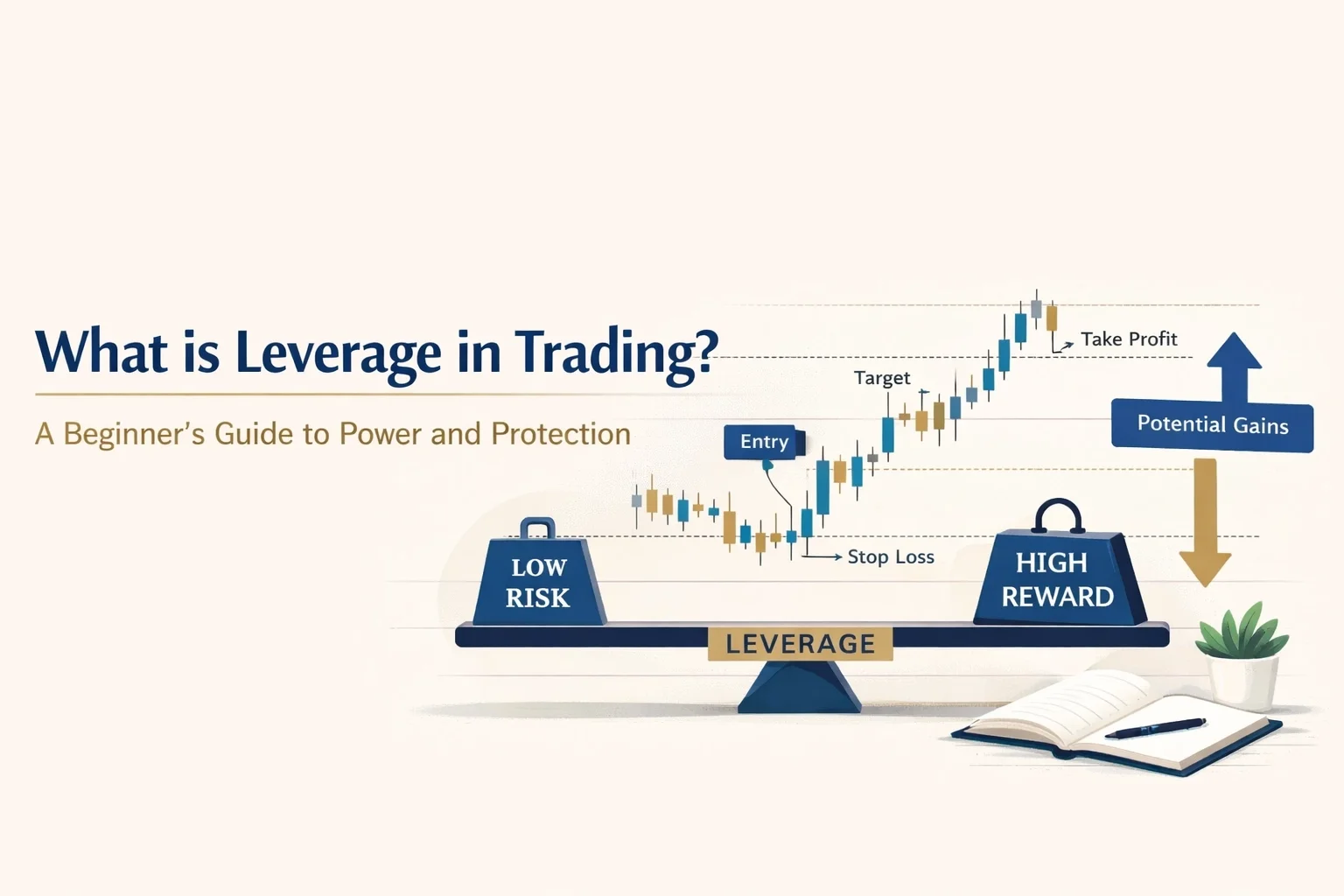
Visual: A candlestick chart showing a potential trade set up in the background. In the foreground there is a scale of leverage balancing the opportunity of low-risk vs high reward.
What is leverage in trading, and why do beginners need to understand it before placing any trades?
Leverage is one of the first concepts new traders hear, but it often sounds more complicated than it really is. At its core, leverage changes how much buying power you can control with the money in your account.
In this first Foundations lesson, the goal is not to make leverage feel exciting. The goal is to understand what it is, how it affects exposure, and how to practice with it safely before moving deeper into chart reading.
What is leverage in trading and how does it work?
Leverage in trading is borrowed buying power that allows you to control a larger position than your account balance would normally allow. It increases both potential gains and potential losses, which is why beginners need to understand it clearly before using it.
Quick Answer: What Is Leverage in Trading?
Leverage increases your buying power
It allows a smaller account to control larger positions
It magnifies losses the same way it magnifies gains.
It should be practiced in a paper trading account before real money is involved.
How Leverage Works
Leverage means your broker allows you to control a bigger trade than the cash sitting in your account would normally allow.
For example, a small account can behave as if it has more buying power behind it. That does not mean you suddenly have more money. It means you are controlling a larger position through borrowed exposure.
This is why leverage matters so much for beginners. A larger position can create larger gains when price moves in your favor, but it can also create larger losses when price moves against you.
Leverage is a tool. It is not an advantage by itself.
Simple Leverage Example
Imagine you have $10 in your account and your broker gives you 1:100 leverage.
That means it is as if you can control a $1,000 position.
If the trade moves in your favor, the gain on that larger position will be bigger than it would be without leverage.
But if the trade moves in the wrong direction, the loss grows in that same proportion.
That is the part beginners need to understand early:
Leverage does not only magnify upside. It magnifies exposure.
How to Practice Leverage Safely in Paper Trading
The best way to understand leverage is to see it inside a simulated account before real money is involved.
Open your TradingView paper trading account and look for the leverage setting in the paper trading panel.
Once you find it, set the leverage to something realistic for where you trade.
If you are in the United States, a common regulated retail benchmark is 50:1.
If you are outside the U.S., use the typical leverage limits where you live and trade.
The point is not to choose the biggest number possible, but to practice with realistic expectations so you can understand how leverage works behind the scenes.
Inside the Foundations Series, this first lesson is simply about getting comfortable with that concept before moving on.
Think of It Like This
Think of leverage like borrowing extra buying power for a trade.
You are still responsible for the full movement of the position you control, even if only a smaller amount of your own money is sitting underneath it.
That is why leverage needs to be understood early. It changes the size of your exposure, not the quality of the trade.

Visual: A clean, white-background chart showing a 1:10 leverage ratio comparison. On one side, a small $1000 icon; on the other, a large $10,000 icon representing the controlled position.
Common Beginner Mistake: Treating Leverage Like a Shortcut
One of the most common beginner mistakes is treating leverage like a shortcut to faster results.
A larger position can look exciting, especially when the math makes the upside seem bigger. But beginners who focus only on the bigger profit number usually miss the real lesson: the downside gets bigger too.
The better approach is to treat leverage as something to understand, not something to chase.
Practice with realistic settings first. Watch how exposure changes. Keep the lesson simple.
Leverage is a tool, not a shortcut.
Most beginners do not struggle because they lack effort. They struggle because they try to stack too much too early, and the information is scattered.
Learn It in Order
Inside Foundations, these concepts are taught step by step so you can understand what you are looking at on the back end, before moving into execution.
Key Takeaways
Leverage is borrowed buying power.
Leverage allows a smaller account to control a larger position.
It magnifies losses the same way it magnifies gains.
The safest place to learn leverage is in paper trading.
The goal of Lesson 1 is understanding exposure, not chasing bigger trades.
Frequently Asked Questions
What is leverage in trading in simple terms?
Leverage is borrowed buying power that allows you to control a larger position in the market than your account balance would normally allow. It increases both potential profits and potential losses.
Is leverage good for beginner traders?
Leverage is a tool, not an advantage. For beginners, it should be used carefully and practiced in a paper trading environment first. Without proper risk management, leverage can quickly lead to losses.
Why does leverage increase losses too?
Because leverage increases the size of the position you control. If price moves against that larger position, the loss is magnified just like a gain would be.
Is leverage the same as margin?
Leverage and margin are closely related. Margin is the amount of money you put up to open a trade, while leverage determines how much larger of a position you can control with that margin.
Next Step
Now that you understand how leverage affects buying power and exposure, the next step is learning how price actually moves on a chart.
Read next: What Is a Candlestick in Trading?
This Concept Is Part Of: The Agorion Method
This concept is part of the Agorion Method, specifically within the Foundations stage where traders learn to build structure before execution.
Leverage is introduced early so beginners understand exposure clearly before moving deeper into reading the market one step at a time.
If you want to follow this process from the beginning, start with the Learning Path so you can see how the Agorion Method is designed to build skill step by step.
Continue the Foundations Learning Path
The Foundations Series was created to give women entering day trading a clear step-by-step path to understanding the markets without the noise or overwhelm common in traditional trading education.
Foundations Series Lesson Index
Lesson 1 - What is Leverage in Trading? (← You are Here)
Lesson 2 - What is a Candlestick in Trading? (Next Article)
Lesson 3 - Understanding the Exponential Moving Average (EMA)
Lesson 4 - Using the Long/Short Tool to Plan Trades
Lesson 5 - What does a Trending Market Look Like?
Lesson 6 - What is Consolidation in Trading?
Lesson 7 - Spread Basics for Beginner Traders
Lesson 8 - Understanding Market Hours in Trading
Lesson 9 - Risk Management Fundamentals
Lesson 10 - What is Margin in Trading?
Lesson 11 - How These Trading Foundations Work Together
By Rachel Pennington
Rachel Pennington is the founder of The Agorion Collective, a structured trading education platform designed to educate and support women building real skill in the market. Her approach is rooted in clarity before complexity, teaching traders to understand price, manage risk, and develop their own process step-by-step.