
Best Day Trading Communities for Women (And Why They Matter)

Trading is often portrayed as a solo endeavor, one person, a few monitors, and a quiet room. But for beginners, especially women entering a male-dominated financial space, that isolation can be the biggest hurdle. It’s easy to get lost in the noise when you don’t have anyone to bounce ideas off of or a place to ask "silly" questions without judgment.
Most people don’t fail because of trading itself; they fail because they try to do it alone. The mental load of interpreting charts while managing your own psychology is heavy. Without a sounding board or a structured environment, that weight often leads to "analysis paralysis" or, worse, impulsive decisions based on a lack of clarity. Finding the right day trading community for women can be the difference between feeling lost and building real confidence in the market.
If you're starting from zero, this guide connects directly to our Foundations Series — where we break down the core concepts of trading step-by-step so you can build real understanding without jumping between disconnected strategies. If you're looking for a full overview of how we approach this journey, our Day Trading for Women: A Beginner’s Guide to Getting Started walks through how all of these pieces fit together.
What Is a Trading Community?
A real community is more than just a chat room or a Discord server filled with green "profit" screenshots. It is certainly not a place for "signals" where you blindly copy what someone else is doing. In the world of retail trading, many groups labeled as "communities" are actually just marketing funnels designed to keep you dependent on a "guru" or ever changing strategies that rely on “changing markets” so you can never leave.
A true day trading community for women is a structured educational ecosystem. We define it through three specific lenses:
A Learning Environment - A place where education is the primary goal and questions are encouraged as part of the process.
A Shared Structure - A group where everyone is speaking the same language and following the same logical path, rather than debating which "indicator" works best.
Guided Growth - An environment where you have a roadmap, real access to educators/mentors, and can see the progress of those who have walked the path before you.
How It Works (The Power of Shared Learning)
Think of learning to trade like learning mathematics. You wouldn’t start by trying to solve complex calculus equations while sitting alone in a basement. You would start by learning to count (1, 2, 3), then move to addition, then subtraction.
In a classroom setting, when you’re learning that 2 + 2 = 4, you benefit from hearing your peers ask questions you hadn't thought of yet. You benefit from seeing the teacher work through the problem on the board. A trading community works the same way. When you see another woman post a chart markup of a trending market and a mentor provides feedback, your own understanding of that concept deepens, even if you weren't the one who posted the chart.
A structured community takes the "guesswork" out of the equation. Instead of wondering if you're "counting" correctly, you have a group of peers and mentors who can confirm your logic. This shared verification is what builds the confidence necessary to eventually trade live markets. Not all communities are built for learning, many are built for attention, and that difference determines whether you gain skill or stay dependent.
Common Beginner Mistakes in Trading Groups
The "isolation problem" often drives beginners to the opposite extreme: joining too many groups. This leads to several common pitfalls that can actually set your progress back by months or even years.
Chasing Signals: Many trading communities for women (and general groups) focus on "buy here, sell there" alerts. This creates a dangerous dependency. If the person giving the signals stops, you are left with zero skills.
Group Hopping: Jumping between five different Discord servers means you are listening to five different "languages" of trading. One person is talking about RSI, another about "hot tips," and another about complex algorithms. This leads to total confusion.
Hype Culture: Avoid groups that feel like a casino. If the main topic of conversation is "how much money we made today" rather than "how well we followed our process," it is a distraction, not a community.
The "Fast Money" Trap: Any group promising quick wins or "hidden secrets" is usually ignoring the reality of risk management.
For a deeper dive into avoiding these early traps, check out our guide on How Women Can Start Day Trading With No Experience.
How to Practice This Safely
The right community provides a "sandbox" for you to play in before you ever put real capital at risk. Practice shouldn't happen in a vacuum. Here is how we suggest using a community to practice safely:
Logic Checks: Before you even think about a "trade," practice identifying market states. Post a chart and ask, "Does this look like consolidation to the rest of you?"
Peer Review: Share your use of tools, like the Long/Short tool. Let others check if your risk-to-reward ratio makes sense based on the Foundations you've learned.
Shadowing: Watch how more experienced members navigate a quiet market versus a volatile one. Learning when not to trade is a skill best learned by observing a disciplined trader/mentor.
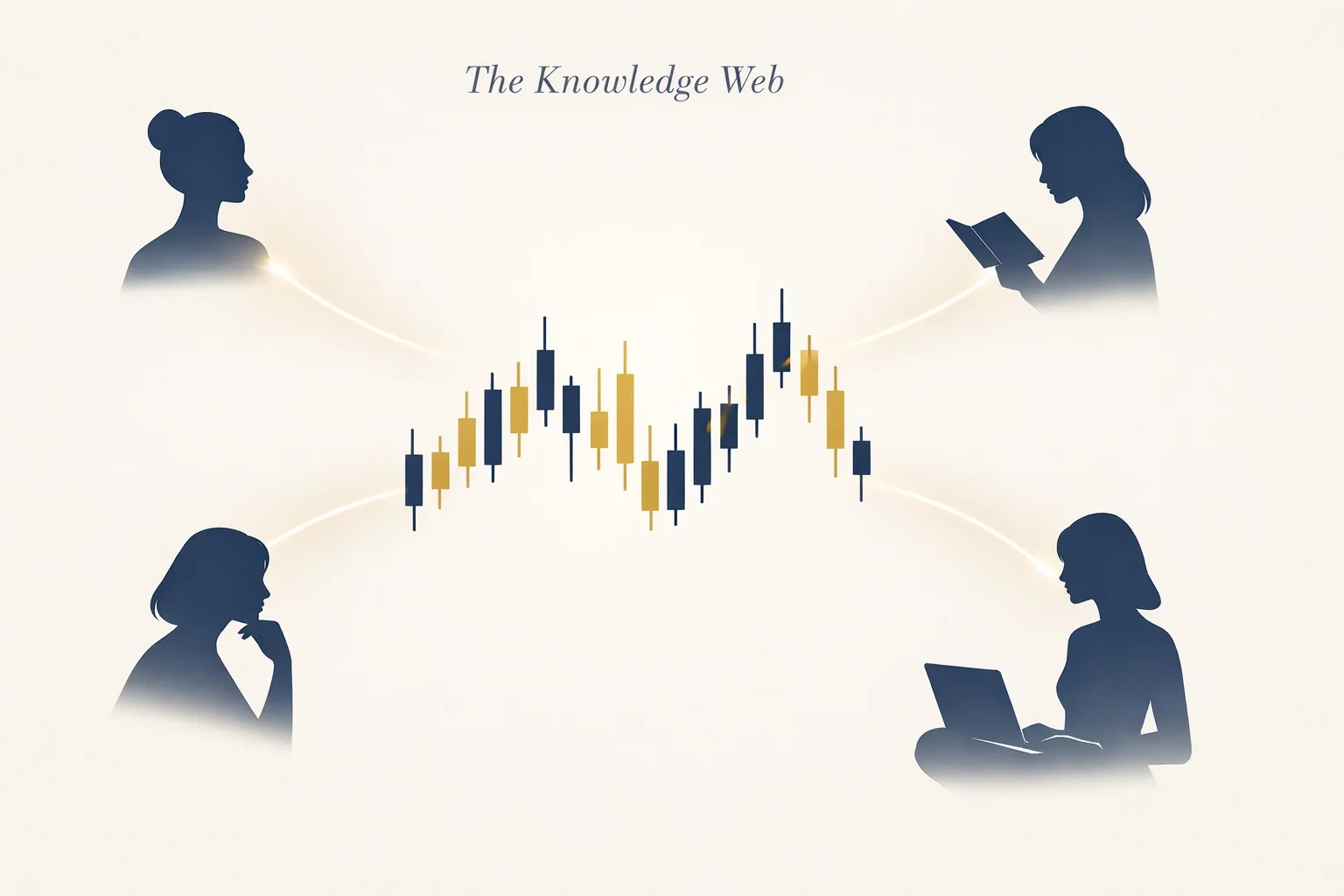
The Mindset Layer: Why Women Succeed in Calm Environments
The environment you learn in directly impacts how you make decisions as a trader. Many public trading spaces are high-testosterone, aggressive, and urgency-based. This "hunter" mentality often leads to over-trading and poor risk decisions.
Women, statistically, tend to be more risk-averse and process-oriented. In a calm, dedicated environment, these traits become a superpower. A community that values clarity before complexity allows women to lean into their natural strengths: patience, discipline, and a willingness to follow a structured plan.
When the environment is calm, your nervous system remains regulated. A regulated trader makes rational decisions; an agitated trader makes expensive mistakes.
Why This Matters in a Structured Learning Path
At Agorion, we believe that your progression should follow a specific order. You cannot skip steps and expect consistent results. We view the learning path as a three-part system:
The Knowledge (Foundations): You learn the basic "numbers" of the market, candlesticks, trends, and risk tools. You can find these basics in our Foundations Series.
The Support (Community): This is where the knowledge is tested. You ask questions, watch others, and get feedback. This bridge ensures you aren't misinterpreting the concepts.
The Application (Practice): Once the community helps you gain clarity, you move toward individual practice with a high degree of confidence in your process.
Without that middle piece, the community, the bridge between "knowing what a candlestick is in trading" and "executing a disciplined trade" often breaks. The right community doesn't just give you information; it gives you the direction to use that information correctly.
Summary
The right community doesn’t just give you information, it gives you direction. Community matters, but structure matters more. When you find the right environment, it doesn't just make trading easier; it makes it a journey you actually want to stay on. We move from the isolation of the "solo trader" to the strength of a collective learning environment.
Ready to start learning with structure?
Join the Atrium: our free Foundations tier community space where women are building day trading skill together, one step at a time, away from the noise and hype of the traditional trading world. This is exactly why I built a space specifically for women learning how to trade - clear, structured, and pressure-free.
If you’re ready to begin:
Free access. No pressure. Start at your own pace.
Frequently Asked Questions
What is the best trading community for beginners?
The best community is one that offers a structured learning path, prioritizes education over signals, and maintains a calm, supportive environment. Look for a group where the focus is on "how" to trade, not "what" to trade.
Do I need a trading community to succeed?
While it is technically possible to learn alone, a community significantly accelerates the process. It helps you avoid the "trial and error" phase that costs most beginners their entire trading account. It provides accountability that is nearly impossible to maintain solo.
Are trading groups worth it?
They are worth it if they provide a structured environment and focus on long-term skill development. They are rarely worth it if they only focus on "hot tips," signals, or "get rich quick" schemes.
How do I choose the right trading community?
Look for alignment in values. If you value structure, risk management, and a calm approach, seek out communities that explicitly teach those things. If you feel pressured or confused when looking at their content, it's likely not the right fit.
Can women learn trading without a community?
Yes, but many women find that a supportive, women-focused environment makes the process more sustainable. Trading is mentally taxing. Having a "tribe" that understands the specific challenges women face in finance can be the difference between quitting and succeeding.
By Rachel Pennington
Rachel Pennington is the founder of The Agorion Collective, where she teaches women how to approach trading with structure, clarity, and confidence. Her work focuses on helping beginners move from overwhelm to understanding through a clear, step-by-step learning path.