
How Women Can Start Day Trading With No Experience
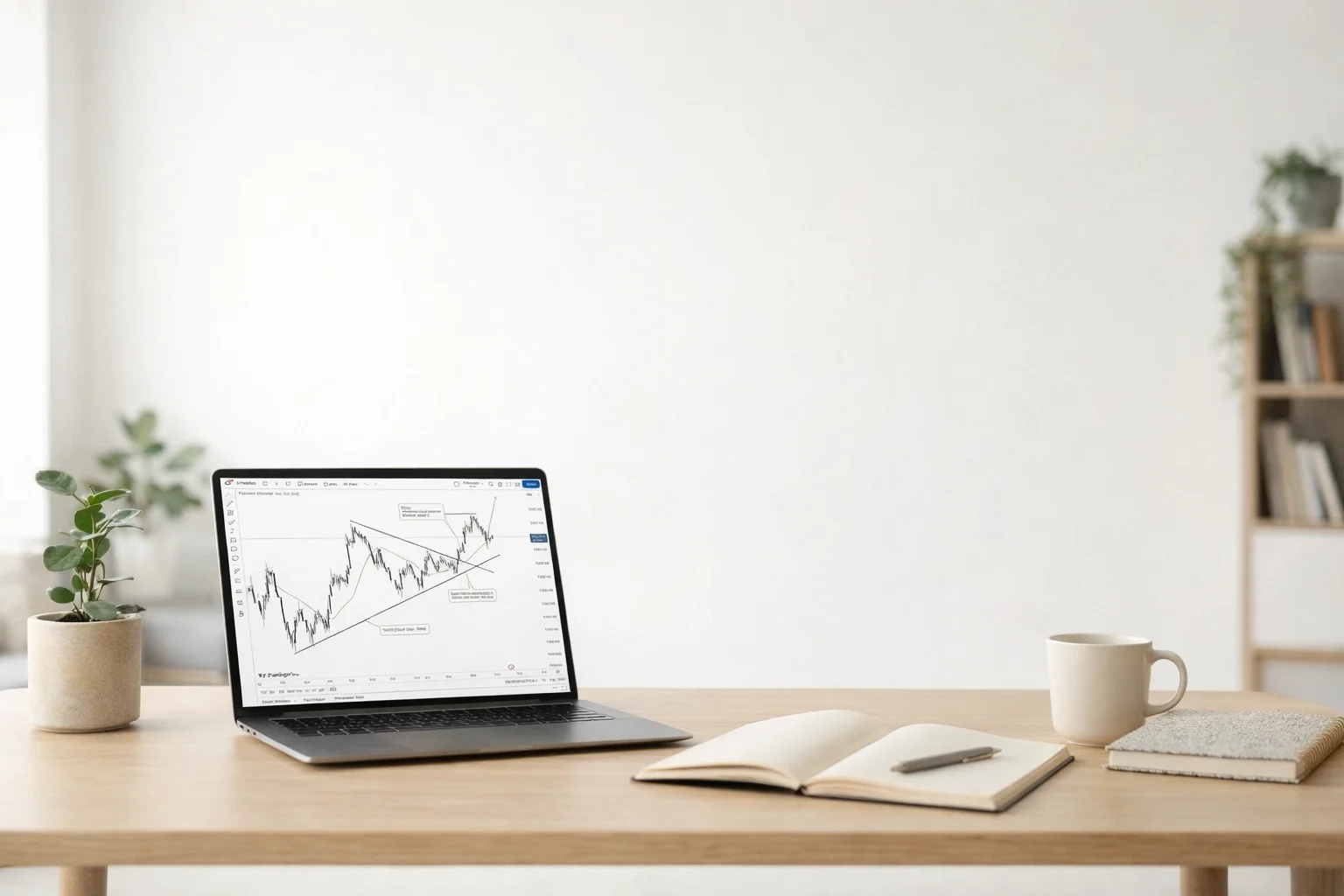
Visual: Clear desk with laptop, journals, and tea cup. A space to intentionally learn about day trading.
Starting day trading can feel like trying to learn a new language while everyone else is already shouting in it. If you have no experience, it’s completely normal to feel a bit overwhelmed. Most people don’t know where to begin, so they just jump into the deepest part of the pool and hope they can swim. If you're looking for a complete overview, our day trading for women beginner’s guide walks through how all of these steps fit together.
The reality is that "how to start day trading as a woman" shouldn't be a search for a secret hack or a complex algorithm. It’s about finding a starting line that doesn't leave you feeling breathless. You don’t need years of finance experience to start day trading; you just need clarity on where to begin. We focus on building a foundation that makes sense, rather than throwing you into the chaos of "hot tips" and high-stress volatile market environments.
If you're starting from zero, this guide connects directly to our Foundations Series, where we break down the core concepts of trading step-by-step so you can build real understanding without jumping between disconnected strategies.
Why “No Experience” Is Actually an Advantage
Most people think they are at a disadvantage because they don’t know the jargon or the "secrets." In reality, having no experience is a huge win. When you start trading with no experience, you are a clean slate. You haven’t picked up bad habits, you haven’t been burned by misinformation from "fin-fluencers," and you don’t have to unlearn expensive mistakes.
Think of it like learning math. You wouldn't try to solve complex calculus before you've learned how to count to ten or perform basic addition. If you skip the numbers and go straight to the formulas, you'll be lost. In trading, we start by learning to count. Understanding the basic movement of price, before we ever try to "do the math" of a complex trade. When you start day trading with zero topical knowledge, this allows you to build your skill correctly from the ground up. In trading, structure matters more than prior knowledge.
The Wrong Way to Start (Quick Contrast)
Most beginners fail due to starting in the wrong order, not a lack of ability. They see a "get rich" video, open a live account with real money, and try to copy a day trading strategy they don't understand.
Jumping into live trading too soon: Risking rent money before you know how a candlestick works.
Watching random, disconnected videos: Learning a piece of "Strategy A" and a piece of "Strategy B" that don't actually work together.
Trying multiple strategies at once: Changing your mind every time a trade goes wrong.
If you don't follow a logical path, you're not trading, you're gambling. We’re here to help you move away from that chaos and into a system that actually works. We believe in Clarity Before Complexity, ensuring you understand the "why" before you focus on the "how much." Starting day trading with no experience doesn’t require a financial background, you only need a clear path.
The Right Way to Start (Step-by-Step)
This is how you build a long-term skill that gives you confidence and independence. Follow these steps to ensure you are climbing each rung of the day trading ladder intentionally.
Step 1 : Learn How the Market Moves
Before you look for a "trade," you need to understand the language of the chart. That starts with candlesticks. Every bar on a chart tells a story of who won the battle between buyers and sellers in a specific timeframe. Understanding the basics of candlestick antomy in trading is your first step in chart literacy.
Step 2 : Understand Market Structure
Is the market going up, down, or nowhere? This is the most basic level of "counting." You need to be able to tell the difference between what a trending market looks like in trading and what consolidation is in trading. If you can't identify the direction, you shouldn't be in the market.
Step 3 : Learn Risk Before Profit
The most important skill in day trading isn't making money; it's capital protection. You must understand mastering risk management before you ever think about how much money you can make. We teach you to calculate exactly what you are willing to lose before you even enter a position.
Step 4 : Set Up a Practice Environment
We use TradingView for our charting. It’s the gold standard for modern traders. Instead of using real money, you should start with a paper trading account. This allows you to practice with "play money" while you learn the tools. It’s the flight simulator for traders, get your hours in here before you take off for real.
Step 5 : Follow a Structured Path
Avoid random learning. Stick to one system and learn it layer by layer. This is why we created the Agorion Foundations Series, to give you that path. It’s a roadmap that keeps you from getting distracted by the "noise" of the broader market.
Step 6 : Learn With the Right Support
Trading can be lonely, but it doesn't have to be. Finding a community of like-minded women provides the guidance and accountability you need to stay the course. Our Beginner’s Guide to Day Trading for Women explains how a supportive environment can accelerate your learning without the typical "bro-culture" pressure.
What to Expect in the Beginning
Confusion is normal. In fact, if you aren't a little confused at first, you probably aren't paying attention. You are training your brain to see patterns in what looks like random noise.
Slow progress is also normal. We prioritize calm learning over fast (and usually temporary) wins. You wouldn't expect to be a surgeon in a week; give yourself the grace of being a student for a period. Consistency matters more than speed, and it compounds. If you spend 20 minutes a day, for a couple weeks, intentionally focused on key concepts, you will be miles ahead of someone who spends 5 hours one weekend and then gives up

Visual: Upward stair stepping blocks, small, compounded choices increase likelihood for success.
Common Beginner Mistakes
Rushing to use real money: The market will be there tomorrow. Don't rush the learning phase.
Overtrading when the market is quiet: Sometimes the best trade is no trade at all.
Skipping the fundamentals: Trying to use leverage or margin before you understand the basic mechanics. For example, understanding what spread is, in day trading can save you a lot of confusion regarding why your trade didn't start in profit.
Simple Weekly Plan
To make this actionable, here is a simple way to structure your first few weeks. This turns a big goal into small, manageable numbers.
3–4 Days/Week (Learning): Spend 20-30 minutes on a single core concept. One day, study 9 and 21 EMAs. The next, practice using the Long/Short tool. There are recorded videos inside our free community that go into detail on how to use both of these.
2–3 Days/Week (Observation): Open a live chart (even if you aren't trading) and just observe. Drop down to a lower time frame, 5 or 15 minute, but don't look for entries. Just watch how price reacts at certain times of the day or how it reacts around EMAs or market structure. Intentionally try to identify patterns in how the market feels during specific market hours.
Daily (Journaling): Write down one thing you observed. It could be as simple as "The market moved sideways for two hours today." This builds the habit of mindfulness.
This is how you build consistency without overwhelm - small, repeatable actions over time. Your daily 1% will compound.
Summary
You don’t need more information, you need the right starting point. Start simple, follow the structure, and build slowly. Confidence doesn't come from luck or a "gut feeling"; it comes from a deep, disciplined understanding of the market.
By focusing on clarity before complexity, you are giving yourself the best possible chance to succeed where others fail. Take it one step at a time, learn to count before you do the math, and remember that the goal is a sustainable skill, not a quick win.
Ready to start learning with structure?
Join the Atrium, our free Foundations tier, women’s community space. A calm, focused, and supportive environment designed to help you build real understanding. You don’t need to figure this out alone or piece things together from random videos.
If you’re ready to start with a clear, structured path:
Free access. No pressure. Start at your own pace.
Frequently Asked Questions
Can I start trading with no experience?
Absolutely. Most of our most successful traders started with zero knowledge. Having a clean slate allows you to learn the right habits from day one without the "noise" of previous failed attempts or incorrect theories.
What should I learn first in trading?
Start with the basics of price movement and candlesticks. You need to be able to "read" the chart before you can trade it. Think of it as learning the numbers 1 through 10. Once you know the numbers, you can start learning how to add them together.
Is day trading realistic for beginners with no experience?
Yes, when approached with structure and patience. The goal isn’t to make money immediately, but to build understanding first. With the right process, beginners can develop the skills needed over time.
Do I need money to start trading?
No. You can (and should) start with a paper trading account on TradingView. This allows you to learn the skill without risking a single dollar of your own capital while you are still in the student phase.
How long should I practice before trading live?
There is no set timeline, but we recommend practicing until you have a clear, consistent process and can execute your setup without emotional stress. For most, this takes hours of consistent "flight simulator" time. Don’t count the hours trying to reach a set number. Stay in demo until you can explain your strategy clearly, have parameters set for risk management, and have enough data through back/forward testing that you feel confident you can execute your plan repetitiously.
What is the safest way to start trading?
The safest way is to start with education and paper trading. Follow a structured path and prioritize risk management above all else. Never trade with money you cannot afford to lose.
By Rachel Pennington
Rachel Pennington is the founder of The Agorion Collective, where she teaches women how to approach trading with structure, clarity, and confidence. Her work focuses on helping beginners move from overwhelm to understanding through a clear, step-by-step learning path.