
Why More Women Are Getting Into Day Trading (And What It Means)
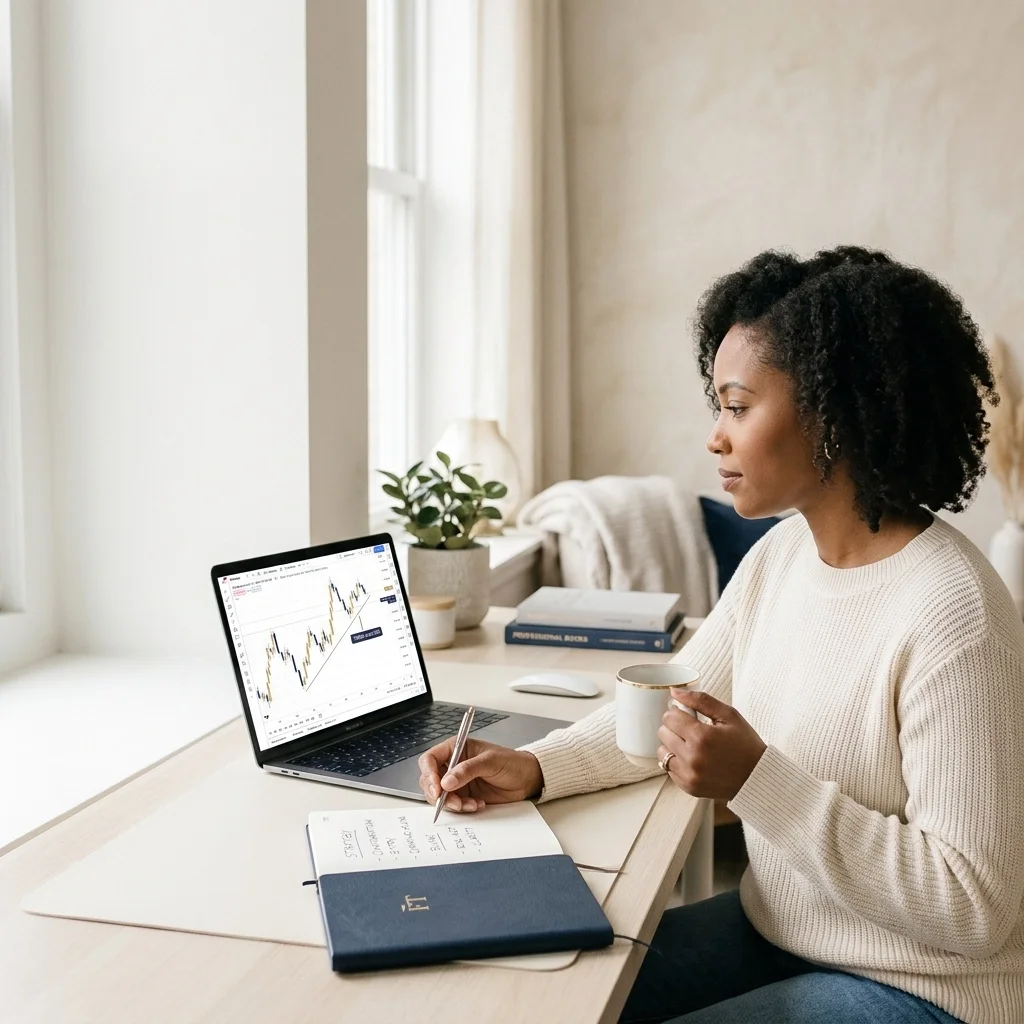
Visual: A woman at an uncluttered desk, studying a simple candlestick chart, while journaling her trades from the day.
If you’ve spent any time looking at the financial markets lately, you may have noticed a shift. The image of the “typical trader” is changing. More women are entering the world of day trading than ever before. They are not just participating but approaching the market with a level of discipline that supports long-term success.
If you're starting from zero, this guide connects directly to our Foundations Series, where we break down the core concepts of trading step-by-step so you can build real understanding without jumping between disconnected strategies.
If you're looking for a full overview, our day trading for women beginner’s guide walks through how all of these pieces fit together.
The Shift in the Trading Landscape
For a long time, day trading was viewed as a closed-off industry. It was something that happened on loud exchange floors or behind the doors of high-rise offices. That reality has changed.
Today, the barriers that once kept people out have largely disappeared. Access to markets, tools, and education is no longer limited to a select group. Women are increasingly visible in the space, sharing their charts, routines, and progress, and that visibility is changing perception.
Trading is not a “boys’ club.” It’s a skill-based environment. The market doesn’t care who is placing the trade; it only responds to how well you understand price and manage risk.
Day trading is no longer a niche path. It’s becoming accessible to anyone willing to learn it the right way.
Why This Is Happening Now
There isn’t one single reason behind this shift. It’s the result of several changes happening at the same time. Things like technology, education, accessibility, and evolving priorities all contribute.
Accessibility of Tools
In the past, market access required expensive software and institutional-level resources. Today, platforms like TradingView provide professional-grade charting to anyone with an internet connection.
You can analyze the same price data as a Wall Street firm from your own desk. The playing field, at least in terms of access, has leveled significantly.
Flexible Learning
Education is no longer confined to rigid environments. Learning has become flexible and self-paced, making it possible to build a new skill alongside an existing career or family responsibilities.
Online communities have also replaced isolation. Instead of figuring everything out alone, beginners now have access to structured spaces where they can ask questions and learn without pressure.
Desire for Financial Independence
There is a growing awareness around the importance of having control over your income and long-term financial future.
Trading offers something different from traditional career paths. It’s not dependent on a company, a schedule, or a promotion. It’s a skill - one that, when developed properly, becomes a personal asset.
Shift in Awareness
Social media has played a role in increasing exposure. While there is a significant amount of noise, it has also helped normalize the idea that women can and do succeed in trading.
What once felt out of reach is now seen as possible.
The Opportunity in This Space
Women are still relatively early in the trading space compared to the broader population. That presents an opportunity.
Unlike saturated industries where the barrier to entry is high and the path is crowded, trading remains skill-based. There is no ceiling placed by background, education, or title.
Research from institutions like UC Berkeley and Fidelity has shown that women often achieve strong results while taking on less risk - largely due to disciplined decision-making and a lower tendency to overtrade.
This isn’t about chasing a trend. It’s about developing a skill that compounds over time.
The Problem With How It’s Being Introduced
Despite the growth, many people, including women entering the space are still being introduced to trading the wrong way.
The internet is saturated with fast-money narratives and “get rich quick” messaging. These environments prioritize excitement over understanding.
When you start from hype, everything feels overwhelming:
too many indicators
too many strategies
no clear direction
“mentors” who don’t have business teaching
Most beginners fail because they aren’t taught in the right order, not because they aren’t capable of learning how to trade.
Trading is a progression. You cannot expect to navigate fast-moving markets without first understanding the basic mechanics of how price moves. Use our article on candlestick anatomy to start with the basics.
What Women Actually Need to Succeed
Moving from curiosity to competence requires a different approach; one built on structure, not speed.
1. Structure
You cannot build skill by jumping between disconnected information.
You need a clear progression - one that starts with understanding charts and builds toward execution.
You can find that structure in our Foundations Hub, where each concept builds on the last.
2. Risk Awareness
Successful trading is not defined by how much you make. Trading success is defined by how well you manage loss.
Beginners often focus on profit. Professionals focus on preservation.
Understanding risk is what allows you to stay in the game long enough to improve. You can explore this further in our guide to risk management.
3. Patience and Consistency
The market does not move on your timeline.
Learning to wait for the right conditions, and consistently follow your process, is what creates long-term stability.
Consistency is not about winning every trade. It’s about showing up the same way every day.
4. A Calm Learning Environment
Hype creates pressure. Pressure creates poor decisions.
To develop a high-level skill, you need a learning environment that is structured, calm, and focused on process rather than performance.
How This Connects to a Real Learning Path
This shift isn’t just about more participation; it’s about a better approach to learning.
Interest is turning curiosity into intention?
If you’re looking for a clear place to begin, our guide on how women start trading outlines the exact steps to move from confusion to structure.
This isn’t about keeping up with a trend; it’s about building a skill that compounds over time.
What This Means Moving Forward
As more women enter trading, the quality of education will matter more than ever.
The era of scattered, unstructured learning is fading. Those who approach trading as a skill, not a shortcut, will be the ones who succeed.
The opportunity is real. The growth is real.
But the outcome is determined by how you start.
Summary
The rise of women in day trading reflects a broader shift in access, awareness, and opportunity.
The door is open — but what matters most is how you walk through it.
Growth is real. Opportunity is real.
But structure determines the outcome.
Next Step
If you're ready to start learning with clarity and structure, join The Atrium, our free Foundations tier community space where women are building skill step-by-step in a calm, supportive environment.
You don’t need to figure this out alone or piece things together from random videos.
If you’re ready to start with a clear, structured path:
Free access. No pressure. Start at your own pace.
Frequently Asked Questions
Why are more women getting into trading?
Access to better tools, flexible learning environments, and a growing desire for financial independence have made trading more accessible. Women are also recognizing that traits like patience and discipline are major advantages in the market.
Is trading becoming more popular for women?
Yes. Brokerages and educational platforms report steady growth in female participation, supported by increased visibility and access.
Can women build income through trading?
Trading is a skill-based profession. While income is never guaranteed, those who develop strong risk management and consistency can build it into a viable long-term path.
Is day trading realistic for beginners?
Yes — with the right expectations. It requires time, practice, and structure. It is not fast money, but it is a learnable skill.
What is the best way for women to start trading?
Start with understanding charts and risk before placing trades. Focus on structured learning that builds from the ground up.
By Rachel Pennington
Rachel Pennington is the founder of The Agorion Collective, where she teaches women how to approach trading with structure, clarity, and confidence. Her work focuses on helping beginners move from overwhelm to understanding through a clear, step-by-step learning path.