
How to Learn Day Trading Without Overwhelm (A Simple Framework)
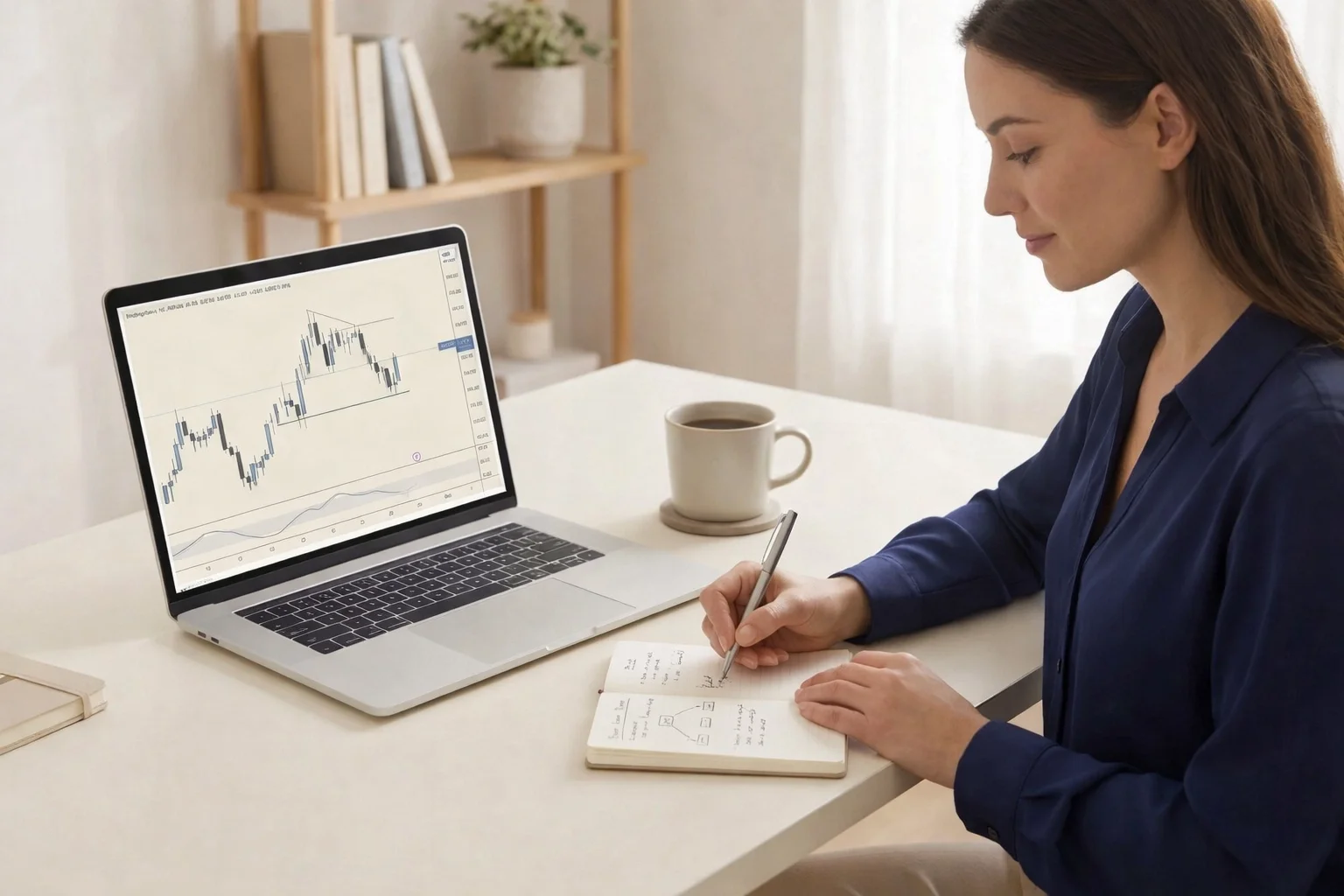
If you have ever opened a trading platform and felt an immediate sense of panic, you are not alone. Day trading is often presented as a chaotic mix of flashing numbers, complex indicators, and conflicting advice. It can feel like you are drowning in information before you have even placed your first practice trade.
If you're starting from zero, this guide connects directly to our Foundations Series; where we break down the core concepts of trading step-by-step so you can build real understanding without jumping between disconnected strategies.
If you're looking for a full overview, our day trading for women beginner’s guide walks through how all of these pieces fit together.
Why Learning Trading Feels Overwhelming
Most beginner traders don’t fail because trading is too complicated. They fail because they’re trying to learn everything at once.
New traders often attempt to understand advanced strategies before they even know how to read a chart. It’s the equivalent of trying to solve complex algebra equations before understanding the basics of counting.
Overwhelm in trading usually comes from three places:
No clear starting point
Too much information
No structured progression
Without a clear sequence, nothing sticks. You end up consuming more and understanding less. At The Agorion Collective, we believe overwhelm is not caused by complexity, it’s caused by a lack of structure.
You don’t need more information. You need a clear order to learn concepts.
The Simple Framework for Learning Trading
To move from confusion to clarity, you need a structured progression.
Our framework focuses on building chart literacy first, then layering in tools, mechanics, and decision-making - in that order.
Step 1. Learn How Price Moves
Before using any tools, you need to understand the raw data of the market.
This includes:
Anatomy of a candlestick (what happened during a time period)
Trending market movment (direction of price)
Consolidation (when price is moving sideways - not trending)
If you cannot read price, no indicator will make trading easier.
Step 2. Understand Your Tools
Once you can read price, you can introduce simple tools to help you interpret movement.
We keep this minimal:
EMA the tool to help visualize trend
Long/Short tool to plan trades and visualize risk
These tools are not meant to complicate your chart; they are meant to simplify interpretation.
Step 3. Learn How Trade/Broker Mechanics Work
Now that you can read the chart, you need to understand how your trades interact with the market.
This includes:
Spread (a small cost built into every trade)
Margin (how your broker helps protect your capital, so its harder to over leverage)
You don’t need deep technical knowledge yet, just enough to remove confusion.
Step 4. Build Risk Awareness Alongside Strategy
Risk management develops alongside your strategy, not before or after it.
As you learn how to read the market and plan trades, you should also be thinking about what you’re willing to risk. The two work together, shaping each decision you make.
Risk is not a separate step, it is part of every trade.
Step 5. Practice Without Pressure
This is where learning turns into skill.
Use TradingView for:
Paper trading
Backtesting
This allows you to build experience without emotional pressure.
Think of it like a simulator, you are learning the environment before putting real capital at risk.
What This Framework Does for You
When you follow a structured path, learning stops feeling overwhelming and concepts start feeling predictable.
Instead of guessing what to learn next, you know exactly where you are in the process.
This creates:
clarity
confidence
consistency
You move from reacting to the market → to understanding it.
What To Avoid as a Beginner
It’s just as important to know what to avoid.
Don’t jump between strategies
Don’t overload your charts
Don’t rush into live trading
The market is not going anywhere.
Trying to speed up the process is what usually slows progress down.
What Progress Actually Looks Like
In the beginning, progress is not measured by profit.
It’s measured by clarity.
Progress in trading looks like understanding what you’re seeing; not constantly placing trades.
If you can open a chart and confidently identify trend and consolidation, you are moving forward.
Clarity always comes before complexity.
Summary of the Framework
Learning trading without overwhelm comes down to structure:
Overwhelm is a structure problem, not a complexity problem
The solution is a clear progression from price → tools → mechanics → risk → practice
Real progress is clarity, not speed!
When you follow a structured path, the process becomes predictable, and that’s what allows compoundable skill to develop over time.
Next Step
If you’re looking for a place to follow this framework step-by-step, The Atrium - our Foundations tier is where that process begins.
We’ve designed it as a calm, structured environment where women can build real day trading skill without the noise.
Trading can feel overwhelming at first, but it doesn’t have to be.
Start with a simple, step-by-step approach designed for beginners:
Free access. No pressure. Start at your own pace.
Frequently Asked Questions
How do beginners learn trading step by step?
By following a structured progression — starting with price movement, then tools, then trade mechanics, and finally risk management and execution.
What is the best way to start trading?
Start with chart literacy and practice on a demo account before risking real capital.
Why is trading overwhelming?
Because most people try to learn everything at once without structure, leading to confusion.
How long does it take to learn trading?
The timeline looks different for everyone, but a solid foundation can be built with consistent, focused study over a few weeks. From there, progress becomes less about time and more about experience — developing discipline, understanding your behavior, and refining your process.
There isn’t a fixed timeline or a “finish line” in trading. What matters is staying consistent, following a structured path, and focusing on your own progress instead of comparing it to others.
Can I learn trading without a mentor?
Yes, but a structured system or environment can significantly shorten the learning curve. Even something as simple as getting quick answers on charting templates significantly decreases your learning curve.
By Rachel Pennington
Rachel Pennington is the founder of The Agorion Collective, where she teaches women how to approach trading with structure, clarity, and confidence. Her work focuses on helping beginners move from overwhelm to understanding through a clear, step-by-step learning path.