
How Trading Foundations Work Together: Building a Simple, Structured Approach
Have you ever felt like you were learning the pieces of trading, but still could not see how they fit together?
You learn what a candlestick is.
You understand leverage.
You know risk management matters.
But instead of feeling clear, it can still feel scattered.
That is where many beginners get stuck.
The problem is usually not a lack of information. It is a lack of structure.
This article brings the Foundations Series together so you can see how the core concepts connect into one simple, structured approach.
How do trading foundations work together?
Trading foundations work together by helping you understand three things in order: what the market is doing, how a trade functions, and how to protect your capital. When those pieces connect, trading starts to feel less random and more structured.
Quick Answer: How Trading Foundations Work Together
The Foundations Series is not a collection of random lessons.
Each lesson teaches part of a larger system.
That system helps you understand:
what price is doing
how trades work
how risk is managed
When those pieces connect, trading becomes much easier to understand.
The Shift: From Random to Structured
Many beginners try to learn trading by jumping from one idea to the next.
One day it is indicators.
The next day it is strategy.
Then it is a completely different system.
That usually creates more confusion, not more clarity.
At Agorion, the goal is not to collect more information.
The goal is to organize what matters in the right order.
Clarity comes before complexity.
When the pieces are structured correctly, the market starts to make more sense.

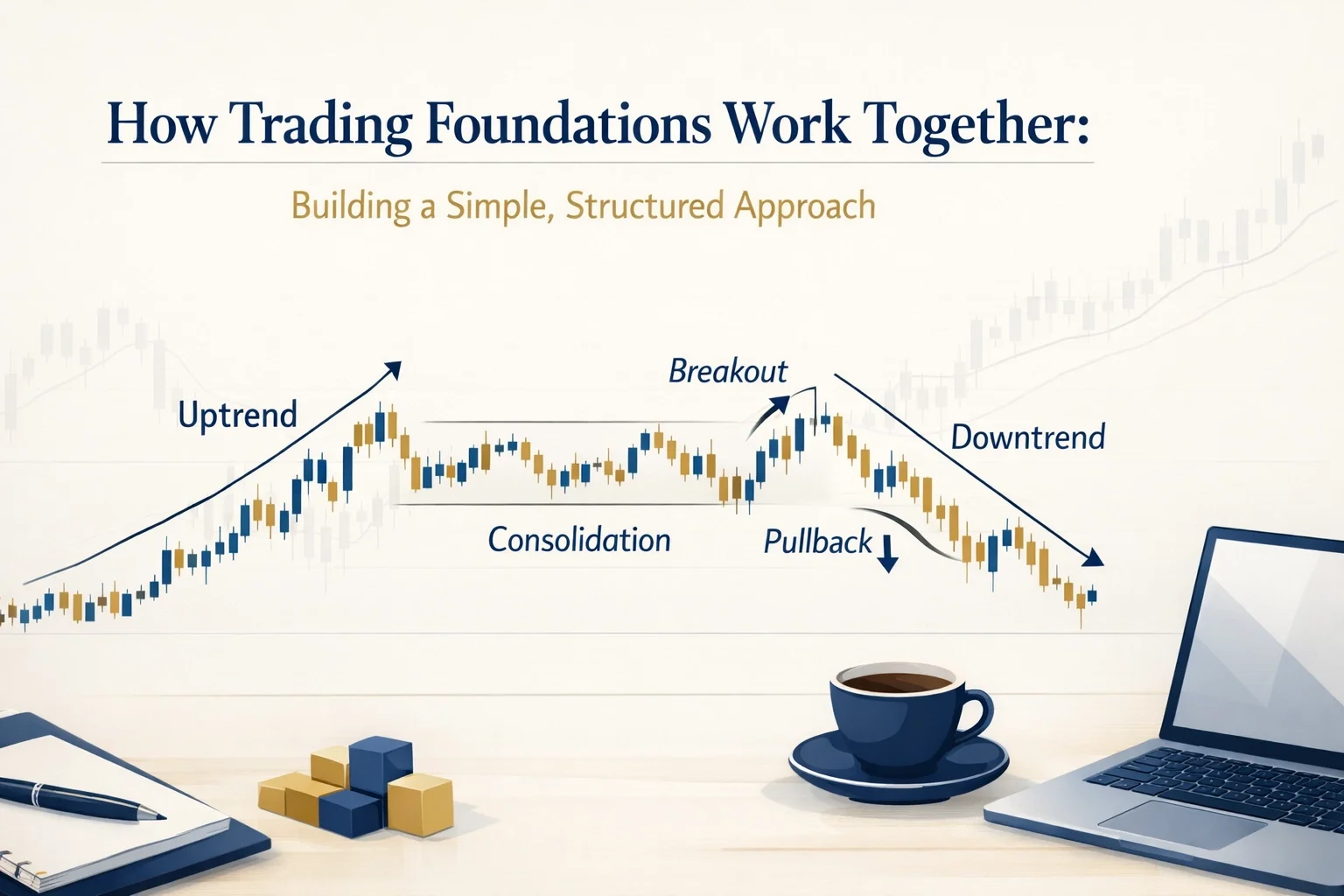
Visual: A candlestick chart built around structure - the pillar of day trading.
How the Pieces Fit Together (The Core System)
Trading isn’t one skill, it’s a system made up of three layers.
When these layers work together, trading becomes clear and repeatable.
1. Market Understanding: The Environment
Before placing a trade, you need to understand what kind of market you are looking at.
This layer includes:
Candlesticks → what price is doing
EMA→ shows direction and flow
Trend vs Consolidation → tells you whether the market is moving clearly or sideways
This layer answers:
“What am I looking at?”
2. Execution Mechanics: How Trades Work
Once you understand the environment, you need to understand how a trade actually functions.
Market Hours → when the market is active
Spread → the cost of entering a trade
Margin → the portion of your account reserved to support the trade
Long/Short Tool → how trade structure becomes visible on the chart
This layer answers:
“How does the trade function?”
3. Capital Protection: The Safety Layer
This is the layer that protects the account while skill is still developing.
This layer includes:
Risk Management → defines how much you are willing to lose before entering
position size and trade structure working together to control exposure
This layer answers:
“How do I stay in the game?”
When all three layers work together, trading stops feeling random.
It becomes a structured decision process.
What This Looks Like in Practice
Instead of reacting emotionally, you begin following a process.
You identify the environment.
You read direction more clearly.
You understand how the trade functions.
You define risk before entering.
Then you execute with more structure.
That is the real shift.
Not from beginner to expert overnight.
But from random to structured.
Think of It Like This
Think of the Foundations Series like building the picture on the front of the puzzle box.
Each lesson gives you another piece.
On its own, each piece matters.
But once the pieces are connected, the full image becomes much easier to understand.
That is what this article is meant to do.
Common Beginner Mistake: Treating Every Concept Like a Separate Skill
One of the most common beginner mistakes is treating every concept like it exists on its own.
A trader learns candles, then risk, then leverage, then trend, but never connects them into one process.
That is where trading starts to feel scattered.
The better approach is to see each concept as part of the same system.
You learn to see before you learn to act.
Most beginners do not struggle with effort. They struggle with structure.
Learn It in Order
If trading still feels overwhelming, that is normal.
These concepts are designed to build on each other.
Inside Foundations, the goal is not to rush.
It is to understand the pieces in the right order so they start working together.
Key Takeaways
Trading foundations work because each concept supports the next one.
The system starts with reading price and understanding the market environment.
Then it teaches how trades function.
Then it teaches how risk is controlled.
When those layers connect, trading becomes more structured and less confusing.
The goal is not more information. The goal is clearer understanding.
Frequently Asked Questions
Do I need a strategy before I start trading?
No. Before focusing on strategy, you need to understand how the market works. Without that foundation, strategy usually feels inconsistent and confusing.
Why does trading feel overwhelming at first?
Because most people learn trading out of order. When the concepts are structured properly, the complexity becomes more manageable.
How do I know if I am ready to move forward?
If you can read a chart more clearly, understand direction, and define risk before entering, you have built the kind of foundation that supports the next stage of learning.
Is it normal to still feel unsure?
Yes. Confidence comes from repetition and structure, not from collecting more information.
What should I focus on after Foundations?
Focus on consistency. Keep practicing the same structured process until it feels more natural before adding more complexity.
Next Step
Now that you can see how the pieces fit together, the best next step is to return to the Foundations Hub and review the full series as one connected system.
This Concept Is Part Of: The Agorion Method
This article is part of the Agorion Method as the Foundations wrap / synthesis article. Its role is to help you see how the lesson concepts connect before you move deeper into the learning progression.
Foundations Series Overview
The Foundations Series was created to give women entering day trading a clear step-by-step path to understanding the markets without the noise or overwhelm common in traditional trading education.
Foundations Series Lesson Index
Lesson 1 - What is Leverage in Trading?
Lesson 2 - What is a Candlestick in Trading?
Lesson 3 - Understanding the Exponential Moving Average (EMA)
Lesson 4 - Using the Long/Short Tool to Plan Trades
Lesson 5 - What does a Trending Market Look Like?
Lesson 6 - What is Consolidation in Trading?
Lesson 7 - Spread Basics for Beginner Traders
Lesson 8 - Understanding Market Hours in Trading
Lesson 9 - Risk Management Fundamentals
Lesson 10 - What is Margin in Trading?
Lesson 11 - How These Trading Foundations Work Together (←You are Here)
If you want to follow the full progression from the beginning, start with the Learning Path so you can see how Foundations connects to the larger Agorion Method.
By Rachel Pennington
Rachel Pennington is the founder of The Agorion Collective, a structured trading education platform designed to educate and support women building real skill in the market. Her approach is rooted in clarity before complexity, teaching traders to understand price, manage risk, and develop their own process step-by-step.